Posts

Differences between 3d printing and molded marble
Image
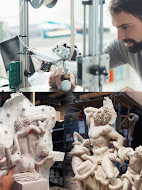
  All our sculptures are made from molded marble, also known as reconstituted marble, never through 3D printers. The molded marble casting process involves marble powder bonded with specific resins (we use cronolite), poured into silicone molds. Many customers wonder about the differences between a sculpture made with 3D printing and those made with molded marble.  The manufacturing processes of 3D printing and casting with molds using marble powder bonded with resin are two very different processes that result in pieces with distinct characteristics in terms of texture, material, and weight.  The key differences are described below: 3D Printing: In 3D printing , pieces are built layer by layer from a thermoplastic material or other materials, melted or deposited by a print head. No physical mold is needed, as the pieces are created directly from a digital model. The materials used in 3D printing cover a wide range, although thermoplastic is common in digital sculptur...

Happy Holidays and Happy New Year 2014

Image
Happy Holidays We wish the Goodness and Beauty  fill your life in this Christmas  and throughout the new year 2024 Decoration with Art

The immortal Don Quixote, a timeless figure

Image
 The silhouettes of  Don Quixote  and his squire  Sancho Panza  are easily recognisable. We know exactly who they are when we see the image of a slender knight with a peculiar helmet atop a gaunt horse and a peasant on a donkey. The sad figure of the Manchegan nobleman has transcended time and space, influencing literature, music, visual arts, even cinema or Broadway musicals. Four centuries after the publication of the two parts of the novel, its iconic image still accompanies us today. Bust of Don Quixote. 39cm The illustrious nobleman Don Quixote of La Mancha  is the masterpiece of the writer  Miguel de Cervantes,  and by extension, of Spanish literature. This novel, published in two parts in 1605 and 1615, tells the story of a nobleman, Alonso Quijano, who, driven by excessive reading of chivalry books, loses his sanity and decides to become a knight-errant under the name  Don Quixote . He convinces a neighboring peasant, Sancho Panza, to...

Dionysus and Cupid by Thorvaldsen

Image
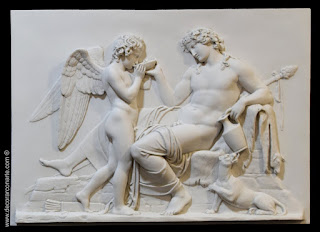
  Among the articles we have in our extensive catalog, today we present this relief of Dionysus with Cupid, a reproduction made in molded marble from the work of the Danish artist Thorvaldsen, one of the foremost representatives of Neoclassicism. Relief of Dionysus with Cupid. 70x51cm Berthel Thorvaldsen by Karl Begas (public domain) Bertel Thorvaldsen was a Danish neoclassical sculptor of the 19th century. His works stand out for their elegance and sensitivity, characterized by clarity and purity of lines, as can be seen in this relief. Albert Bertel Thorvaldsen was born in Copenhagen in 1770 and showed exceptional talent for the plastic arts, particularly sculpture, from an early age. Thorvaldsen studied at the Royal Academy of Fine Arts in Denmark, in Copenhagen, and later moved to Rome on a scholarship. In the Italian capital, the epicenter of Renaissance and classical antiquity art, the Danish artist found inspiration that would shape his style, strongly influenced by the art ...

Buddha Head of Angkor, Serenity and Mystery

Image
Head of  Buda of Banteay,  Angkor.  25 cm One of the most recent additions to our catalog is this reproduction of a Buddha head , inspired by the statues found in the temples of Angkor in Cambodia. In Khmer art from Angkor, there is an abundance of sculptures depicting divine beings from both Hindu and Buddhist religions. Among them, the images of Buddha stand out, often depicted with a serene and smiling face. This Buddha head exhibits the typical characteristics of Khmer human representations in art: a smiling face, almond-shaped eyes, well-defined eyebrows often merging into one, and lips with outlined outer edges.  These representations can be found as standalone sculptures , as reliefs on temple walls, or integrated into the architecture itself, placed above lintels or serving as column capitals. Angkor Thom-Bayon-20-Koepfe-2007-gje by Gerd Eichmann under  CC BY-SA 4.0 DEED Angkor was the capital of the Cambodian Khmer Empire (9th to 15th centu...

The Veiled Vestal by Raffaele Monti

Image
Bust of Veiled Vestal One of the most evocative sculptures in our art reproduction catalog is this bust of the Veiled Vestal , showcasing the delicate work of the veil covering her face. This beautiful piece can add a touch of mystery and serenity to your favorite places of your home: a special boureau in the living room, the reading nook in the library, atop a pedestal in the garden, or inspiring you in your office, when working or studying. Bust of the Veiled Vestal This faithful reproduction of Raffaele Monti's bust of the Veiled Vestal is handmade in our workshops in molded marble (marble dust bonded with resins). Its exquisite finish and the application of aging patinas made from natural earth give it the appearance of a marble statue beautified by the passage of time, making it ideal for decorating outdoor spaces such as gardens, patios, and terraces, as it can withstand exposure to the elements. The measurements of this reproduction are 53 cm in height and 27 cm in w...

A love story in art. Cupid and Psyche

Image
 Classical art is an inexhaustible source of inspiration, not only for its forms and techniques but also for the stories it represents. One of the most popular and well-known is the story of Cupid and Psyche. A love story that dates back to ancient Greek mythology and has been depicted in various art forms, including sculptures. Introduction to Cupid and Psyche Cupid and Psyche is a love story between a god and a mortal. Cupid, also known as Eros in Greek mythology, is the god of love and attraction. Psyche, on the other hand, is a young mortal girl of unsurpassed beauty. The story tells how these two characters meet and face challenges before they live happily ever after. Cupid and Psyche : The Beginning Psyche's beauty was such that it caused mortals to compare her to Aphrodite, the goddess of beauty. Aphrodite, jealous, ordered her son Cupid to make Psyche fall in love with a repulsive man. However, when Cupid saw Psyche, he fell madly in love with her and decided to marry her s...

The Venus of Flora. Statues for gardens

Image
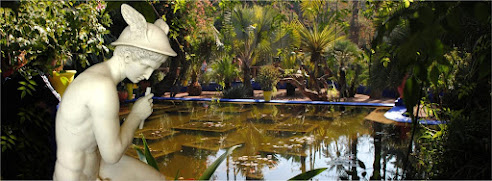
There is nothing better than a sculpture to turn your gardens and terraces into charming spaces. A reproduction of an ancient work of classical art appears among the vegetation, welcoming us to that special corner where we take refuge from the noise and routine of everyday life. We can surround ourselves with art with handcrafted works that faithfully reproduce ancient sculptures such as the one we bring to this blog, the Venus de la Flora. It is a high quality reproduction made with reconstituted marble (marble powder with resin). Finished with an antique patina based on natural earths. The stone texture suggests the feel of an antique original. It is a sculpture perfectly suited for outdoor decoration such as gardens and terraces or for indoors.   Measurements:   Height: 158 cm. Base Measurements: Width: 56 cm. Depth: 40 cm. Height: 14 cm.   This sculpture depicts a female figure holding an amphora. The Roman goddess Venus (Aphrodite in Greece) is the ...

Wall decoration with sculptures on corbels

Image
Corbels with Greek ceramics Wall decoration can acquire an air of distinction if we use decorative elements inspired by classical art , such as Greco-Roman and neoclassical reliefs , combined with corbels that support small sculptures, busts or replicas of Greek ceramics , for example.           Assorted small and medium-sized sculptures   These two elements, reliefs and corbels with busts or sculptures , have been used in different cultures since antiquity for monumental and interior decoration , in temples and palaces, and in the villas and mansions of the distinguished classes.         Classical corbel Corbels are supports that protrude from the wall . They can be used on façades to support horizontal structures such as architraves or friezes, or as interior decorative elements , either free-standing or as a base on which a small or medium-sized decorative figure is placed. They can also be used as legs for tables or consoles a...

Notes for the creation of a neoclassical garden. Nature and sculpture

Image
  Even today, in many of our cities, there are still public parks and gardens created in the neoclassical period and the romanticism of the 19th century, and they are true havens of peace and coexistence in the very heart of the agitation of the city. The union of nature with the works of art created by humans goes hand in hand with the history of human culture. We speak of gardens, open spaces, more or less ordered, or as in the case of romantic gardens, with the appearance of wild and spontaneous nature, although delicately studied. The spirit of this union between mother nature and the love of sculpture is also taken to more intimate spaces in private gardens, small plots, even terraces. The garden thus becomes a sort of natural-cultural art, a union of the beauty of nature and classical art, where sculptures and architectural elements coexist with trees, shrubs and plants of great beauty. This symbiosis is produced through various elements: ...

Sculptures for garden decoration

Image
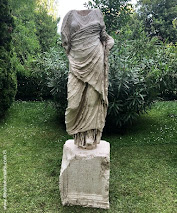
  Roman Torso. H.: 217cm Classical sculptures take us back to other times and evoke reminiscences of Antiquity. With reproductions of Greek and Roman statues we can create unique spaces in our gardens or terraces, enjoying nature and at the same time the artistic creativity of human beings. Decorative figures of all sizes can be placed between hedges and trees, next to swimming pools or artificial ponds. A sculpture of a kind god or a beautiful goddess can surprise us in any corner.   Bust of Diana of Versailles. 32cm Our gardens with romantic, classical, oriental decoration... lend themselves to include some sculptures of classical or exotic inspiration in our catalogue , as an outstanding element. Through art we always express something hidden and beautiful about ourselves. Decorative elements such as cups and planters , fountains and sculptures, made of different materials such as stone and reconstituted marble, bronze or terracotta, are some of the pieces that w...