Posts

Showing posts with the label Sale of canvases

The king and the beggar. Canvas of Edmund Blair Leighton.

Image
The painting "The king and the beggar" by Edmund B Leighton   Edmund Blair Leighton was an English painter of historical genre scenes, specializing in Regency and medieval subjects. He was a fastidious craftsman, producing highly finished, decorative pictures, displaying romanticized scenes with a popular appeal. It would appear that he left no diaries, and though he exhibited at the Royal Academy for over forty years, he was never an Academician or an Associate.   Here you can get the canvases of Edmund Blair Leighton.

The burning of the Houses of Parliament (detail 2). Canvas of William Turner.

Image
The painting "The burning of the Houses of Parliament" by William Turner   Joseph Mallord William Turner (1775 - 1851) was an English painter and the leading representative of the Romanticism; he is one of the greatest English artists. Despite its fast way to work, he created unique works. His main source of inspiration were ships and water, but also dramatic scenes of the nature. Despite that Turner was a romantic painter, was interested in sublime philosophy; portraying the awesome power of nature over man. Fires, disasters, subsidence, natural phenomena are described by the painter. When he died at 76 years, he left to the British government more than 20,000 works. Turner is considered the precursor of Impressionism, because his works stimulated various artists of this style.   Here you can get the canvases of William Turner.

Centaur. Canvas of Gustave Moreau.

Image
The painting "Centaur" by Gustave Moreau   Gustave Moreau born in France in 1826 and died in 1898. Moreau was a French Symbolist painter whose main emphasis was the illustration of biblical and mythological figures. As a painter, Moreau appealed to the imaginations of some Symbolist writers and artists. The works of Moreau are somewhere between the Romanticism and the Symbolism.   Here you can get the canvases of Gustave Moreau.  

Musicians (fragment). Canvas of Albert Joseph Moore.

Image
The painting "Musicians" by Albert Moore.   Albert Joseph Moore was an English painter, known for his depictions of languorous female figures set against the luxury and decadence of the classical world. Initiated in the decorative art, his works, which combine elements Hellenic and pre-Raphaelites, exemplify the Victorian aesthetic. The works of Moore supposed to be a dreamed encounter with the female universal.   Here you can get the canvases of Albert Joseph Moore.  

The Death of Socrates. Canvas of Jacques-Louis David.

Image
The painting "The Death of Socrates" by Jacques-Louis David   Jacques-Louis David (1748 - 1825) was a French painter of considerable influence in the neoclassical style. He sought inspiration in the Greek sculptural and mythological models, based on its austerity and severity, something that coincided with the moral climate of the final years of the old regime.   Here you can get the canvases of Jacques-Louis David.

The golden Stairs. Canvas of Burne-Jones.

Image
The painting "The golden Stairs" by Burne-Jones   Sir Edward Coley Burne-Jones (1833 - 1898) was an English artist and designer and the primarily responsible to attract the Pre-Raphaelites to the mainstream of British art and, at the same time, he made some of the most exquisite and beautiful works of art at this era. Burne-Jones was inspired by mythological themes, as can be seen in his cycle on the myth of Perseus in tempera (1875) or in Atlas turned to stone. Also hosts allegorical themes and historical legends.   Here you can get the canvases of Burne-Jones.  

Naked in the bath. Canvas of Bouguereau.

Image
The painting "Naked in the bath" by Bouguereau   William-Adolphe Bouguereau (1825 - 1905) was a French academic painter and traditionalist. In his realistic genre paintings he used mythological themes, making modern interpretations of classical subjects, with an emphasis on the female human body. During his life he enjoyed significant popularity in France and the United States, was given numerous official honors, and received top prices for his work. As the quintessential salon painter of his generation, he was reviled by the Impressionist avant-garde. By the early twentieth century, Bouguereau and his art fell out of favor with the public, due in part to changing tastes. In the 80s, the revival of interest in figure painting led to a rediscovery of Bouguereau and his work. Throughout the course of his life, Bouguereau executed 822 known finished paintings, although the whereabouts of many are still unknown.   Here you can get the canvases of Bouguereau.  

Call to arms. Canvas of Edmund Blair Leighton.

Image
The painting "Square" by Edmund B Leighton   Edmund Blair Leighton was an English painter of historical genre scenes, specializing in Regency and medieval subjects. He was a fastidious craftsman, producing highly finished, decorative pictures, displaying romanticized scenes with a popular appeal. It would appear that he left no diaries, and though he exhibited at the Royal Academy for over forty years, he was never an Academician or an Associate.   Here you can get the canvases of Edmund Blair Leighton.  

Confidence inopportune. Canvas of Alma-Tadema.

Image
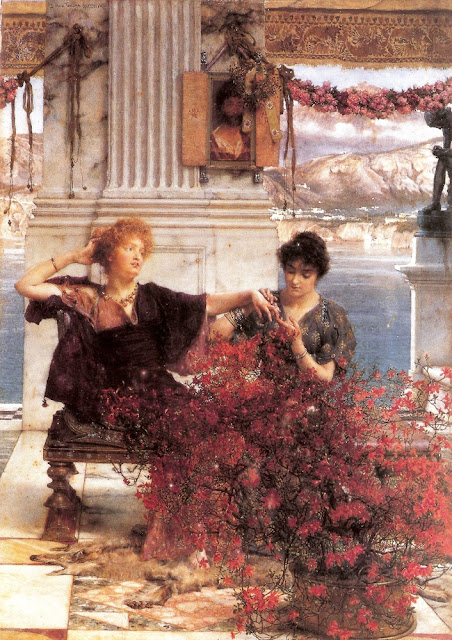
The painting "Confidence inopportune" by Alma-Tadema   Sir Lawrence Alma-Tadema born in Netherlands in 1836 and died in 1912. Sir Alma-Tadema was a Dutch Neoclassical painter of the Victorian era formed in Belgium and established in England since 1870. He is known for its sumptuous paintings inspired in the ancient world. A painter of classical subject, he became famous for his depictions of the luxury and decadence of the Roman Empire, with languorous figures set in marbled interiors or against a backdrop of dazzling blue Mediterranean Sea and sky. Though admired during his lifetime for his citizenship and his depictions of Classical antiquity, his work fell into disrepute after his death, and only since the 1960s it has been re-evaluated for its importance within nineteenth-century English art.   Here you can get the canvases of Alma-Tadema.  

The jeweled fetters of the love. Canvas of Alma-Tadema.

Image
The painting "The jeweled fetters of the love" by Alma-Tadema   Sir Lawrence Alma-Tadema born in Netherlands in 1836 and died in 1912. Sir Alma-Tadema was a Dutch Neoclassical painter of the Victorian era formed in Belgium and established in England since 1870. He is known for its sumptuous paintings inspired in the ancient world. A painter of classical subject, he became famous for his depictions of the luxury and decadence of the Roman Empire, with languorous figures set in marbled interiors or against a backdrop of dazzling blue Mediterranean Sea and sky. Though admired during his lifetime for his citizenship and his depictions of Classical antiquity, his work fell into disrepute after his death, and only since the 1960s it has been re-evaluated for its importance within nineteenth-century English art.   Here you can get the canvases of Alma-Tadema.  

Sapphires. Canvas of Albert Joseph Moore.

Image
The painting "Sapphires" by Albert Moore.   Albert Joseph Moore was an English painter, known for his depictions of languorous female figures set against the luxury and decadence of the classical world. Initiated in the decorative art, his works, which combine elements Hellenic and pre-Raphaelites, exemplify the Victorian aesthetic. The works of Moore supposed to be a dreamed encounter with the female universal.   Here you can get the canvases of Albert Joseph Moore.    

Shells. Canvas of Albert Joseph Moore.

Image
The painting "Shells" by Albert Moore.   Albert Joseph Moore was an English painter, known for his depictions of languorous female figures set against the luxury and decadence of the classical world. Initiated in the decorative art, his works, which combine elements Hellenic and pre-Raphaelites, exemplify the Victorian aesthetic. The works of Moore supposed to be a dreamed encounter with the female universal.   Here you can get the canvases of Albert Joseph Moore.  

King Mark and the Belle Iseult. Canvas of Burne-Jones.

Image
The painting "King Mark and the Belle Iseult" by Burne-Jones   Sir Edward Coley Burne-Jones (1833 - 1898) was an English artist and designer and the primarily responsible to attract the Pre-Raphaelites to the mainstream of British art and, at the same time, he made some of the most exquisite and beautiful works of art at this era. Burne-Jones was inspired by mythological themes, as can be seen in his cycle on the myth of Perseus in tempera (1875) or in Atlas turned to stone. Also hosts allegorical themes and historical legends.   Here you can get the canvases of Burne-Jones.  

Study. Canvas of Burne-Jones.

Image
The painting "Study" by Burne-Jones   Sir Edward Coley Burne-Jones (1833 - 1898) was an English artist and designer and the primarily responsible to attract the Pre-Raphaelites to the mainstream of British art and, at the same time, he made some of the most exquisite and beautiful works of art at this era. Burne-Jones was inspired by mythological themes, as can be seen in his cycle on the myth of Perseus in tempera (1875) or in Atlas turned to stone. Also hosts allegorical themes and historical legends.   Here you can get the canvases of Burne-Jones.

Rapture of Psyche. Canvas of Bouguereau.

Image
The painting "Rapture of Psyche" by Bouguereau   William-Adolphe Bouguereau (1825 - 1905) was a French academic painter and traditionalist. In his realistic genre paintings he used mythological themes, making modern interpretations of classical subjects, with an emphasis on the female human body. During his life he enjoyed significant popularity in France and the United States, was given numerous official honors, and received top prices for his work. As the quintessential salon painter of his generation, he was reviled by the Impressionist avant-garde. By the early twentieth century, Bouguereau and his art fell out of favor with the public, due in part to changing tastes. In the 80s, the revival of interest in figure painting led to a rediscovery of Bouguereau and his work. Throughout the course of his life, Bouguereau executed 822 known finished paintings, although the whereabouts of many are still unknown.   Here you can get the canvases of Bouguereau.  

Choir of angels surrounding the Virgin. Canvas of Bouguereau.

Image
The painting "Choir of angels surrounding the Virgin" by Bouguereau   William-Adolphe Bouguereau (1825 - 1905) was a French academic painter and traditionalist. In his realistic genre paintings he used mythological themes, making modern interpretations of classical subjects, with an emphasis on the female human body. During his life he enjoyed significant popularity in France and the United States, was given numerous official honors, and received top prices for his work. As the quintessential salon painter of his generation, he was reviled by the Impressionist avant-garde. By the early twentieth century, Bouguereau and his art fell out of favor with the public, due in part to changing tastes. In the 80s, the revival of interest in figure painting led to a rediscovery of Bouguereau and his work. Throughout the course of his life, Bouguereau executed 822 known finished paintings, although the whereabouts of many are still unknown.   Here you can get the canvases of Bouguer...

Lady embroidering the Banner. Canvas of Edmund Blair Leighton.

Image
Lady embroidering the Banner by Edmund B Leighton   Edmund Blair Leighton was an English painter of historical genre scenes, specializing in Regency and medieval subjects. He was a fastidious craftsman, producing highly finished, decorative pictures, displaying romanticized scenes with a popular appeal. It would appear that he left no diaries, and though he exhibited at the Royal Academy for over forty years, he was never an Academician or an Associate.   Here you can get the canvases of Edmund Blair Leighton.  

The Kiss. Canvas of Edmund Blair Leighton.

Image
The painting "The Kiss" by Edmund B Leighton   Edmund Blair Leighton was an English painter of historical genre scenes, specializing in Regency and medieval subjects. He was a fastidious craftsman, producing highly finished, decorative pictures, displaying romanticized scenes with a popular appeal. It would appear that he left no diaries, and though he exhibited at the Royal Academy for over forty years, he was never an Academician or an Associate.   Here you can get the canvases of Edmund Blair Leighton.  

Devotional love. Canvas of Alma-Tadema.

Image
The painting "Devotional love" by Alma-Tadema   Sir Lawrence Alma-Tadema born in Netherlands in 1836 and died in 1912. Sir Alma-Tadema was a Dutch Neoclassical painter of the Victorian era formed in Belgium and established in England since 1870. He is known for its sumptuous paintings inspired in the ancient world. A painter of classical subject, he became famous for his depictions of the luxury and decadence of the Roman Empire, with languorous figures set in marbled interiors or against a backdrop of dazzling blue Mediterranean Sea and sky. Though admired during his lifetime for his citizenship and his depictions of Classical antiquity, his work fell into disrepute after his death, and only since the 1960s it has been re-evaluated for its importance within nineteenth-century English art.   Here you can get the canvases of Alma-Tadema.

A consecration to Bacchus (fragment). Canvas of Alma-Tadema.

Image
The painting "A consecration to Bacchus" by Alma-Tadema   Sir Lawrence Alma-Tadema born in Netherlands in 1836 and died in 1912. Sir Alma-Tadema was a Dutch Neoclassical painter of the Victorian era formed in Belgium and established in England since 1870. He is known for its sumptuous paintings inspired in the ancient world. A painter of classical subject, he became famous for his depictions of the luxury and decadence of the Roman Empire, with languorous figures set in marbled interiors or against a backdrop of dazzling blue Mediterranean Sea and sky. Though admired during his lifetime for his citizenship and his depictions of Classical antiquity, his work fell into disrepute after his death, and only since the 1960s it has been re-evaluated for its importance within nineteenth-century English art.   Here you can get the canvases of Alma-Tadema.