Posts

A love story in art. Cupid and Psyche

Image
 Classical art is an inexhaustible source of inspiration, not only for its forms and techniques but also for the stories it represents. One of the most popular and well-known is the story of Cupid and Psyche. A love story that dates back to ancient Greek mythology and has been depicted in various art forms, including sculptures. Introduction to Cupid and Psyche Cupid and Psyche is a love story between a god and a mortal. Cupid, also known as Eros in Greek mythology, is the god of love and attraction. Psyche, on the other hand, is a young mortal girl of unsurpassed beauty. The story tells how these two characters meet and face challenges before they live happily ever after. Cupid and Psyche : The Beginning Psyche's beauty was such that it caused mortals to compare her to Aphrodite, the goddess of beauty. Aphrodite, jealous, ordered her son Cupid to make Psyche fall in love with a repulsive man. However, when Cupid saw Psyche, he fell madly in love with her and decided to marry her s...

The Venus of Flora. Statues for gardens

Image
There is nothing better than a sculpture to turn your gardens and terraces into charming spaces. A reproduction of an ancient work of classical art appears among the vegetation, welcoming us to that special corner where we take refuge from the noise and routine of everyday life. We can surround ourselves with art with handcrafted works that faithfully reproduce ancient sculptures such as the one we bring to this blog, the Venus de la Flora. It is a high quality reproduction made with reconstituted marble (marble powder with resin). Finished with an antique patina based on natural earths. The stone texture suggests the feel of an antique original. It is a sculpture perfectly suited for outdoor decoration such as gardens and terraces or for indoors.   Measurements:   Height: 158 cm. Base Measurements: Width: 56 cm. Depth: 40 cm. Height: 14 cm.   This sculpture depicts a female figure holding an amphora. The Roman goddess Venus (Aphrodite in Greece) is the ...

Wall decoration with sculptures on corbels

Image
Corbels with Greek ceramics Wall decoration can acquire an air of distinction if we use decorative elements inspired by classical art , such as Greco-Roman and neoclassical reliefs , combined with corbels that support small sculptures, busts or replicas of Greek ceramics , for example.           Assorted small and medium-sized sculptures   These two elements, reliefs and corbels with busts or sculptures , have been used in different cultures since antiquity for monumental and interior decoration , in temples and palaces, and in the villas and mansions of the distinguished classes.         Classical corbel Corbels are supports that protrude from the wall . They can be used on façades to support horizontal structures such as architraves or friezes, or as interior decorative elements , either free-standing or as a base on which a small or medium-sized decorative figure is placed. They can also be used as legs for tables or consoles a...

Notes for the creation of a neoclassical garden. Nature and sculpture

Image
  Even today, in many of our cities, there are still public parks and gardens created in the neoclassical period and the romanticism of the 19th century, and they are true havens of peace and coexistence in the very heart of the agitation of the city. The union of nature with the works of art created by humans goes hand in hand with the history of human culture. We speak of gardens, open spaces, more or less ordered, or as in the case of romantic gardens, with the appearance of wild and spontaneous nature, although delicately studied. The spirit of this union between mother nature and the love of sculpture is also taken to more intimate spaces in private gardens, small plots, even terraces. The garden thus becomes a sort of natural-cultural art, a union of the beauty of nature and classical art, where sculptures and architectural elements coexist with trees, shrubs and plants of great beauty. This symbiosis is produced through various elements: ...

Sculptures for garden decoration

Image
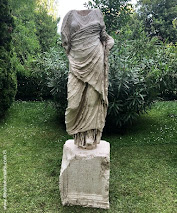
  Roman Torso. H.: 217cm Classical sculptures take us back to other times and evoke reminiscences of Antiquity. With reproductions of Greek and Roman statues we can create unique spaces in our gardens or terraces, enjoying nature and at the same time the artistic creativity of human beings. Decorative figures of all sizes can be placed between hedges and trees, next to swimming pools or artificial ponds. A sculpture of a kind god or a beautiful goddess can surprise us in any corner.   Bust of Diana of Versailles. 32cm Our gardens with romantic, classical, oriental decoration... lend themselves to include some sculptures of classical or exotic inspiration in our catalogue , as an outstanding element. Through art we always express something hidden and beautiful about ourselves. Decorative elements such as cups and planters , fountains and sculptures, made of different materials such as stone and reconstituted marble, bronze or terracotta, are some of the pieces that w...

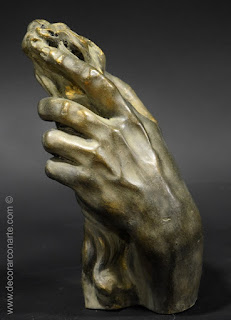
Hand of Zeus carrying the beam. Bronze Alt: 26 cm

Image
Visit in online shop   High quality resin figure made of reconstituted marble (resin + marble powder). Finished imitating the antique  bronze . The pieces are reproductions or inspirations of  Greek , Roman and neoclassical sculptures that transmit a great timelessness to us.

New Product on our website: Bas-relief. Tomb of Ramose.

Image
Visit in online shop Egyptian decorative relief, reproduction made of reconstituted marble (marble powder agglutinated with chronolite) with aged patina, inspired by universal art. Detail of the large scene in relief from the tomb of Ramose (Born of Ra), vizier of the Egyptian king Amenophis III, 18th Dynasty, (around 1370 BC), father of Akhnaton. On this stele we see Ramose and his wife, she tenderly holding him by the shoulder, carrying lotus flowers, linked to immortality, and their faces lit up with a sweet, faraway smile. They wear fine, transparent linen clothes, and their hairstyles were very important. On the original limestone stele, only the colour of the eyes and hairstyles was marked. Measurements: Height: 108 cm. Width: 87 cm. Depth: 3 cm.